Organic traffic kaise badhayein?
08 October 2021
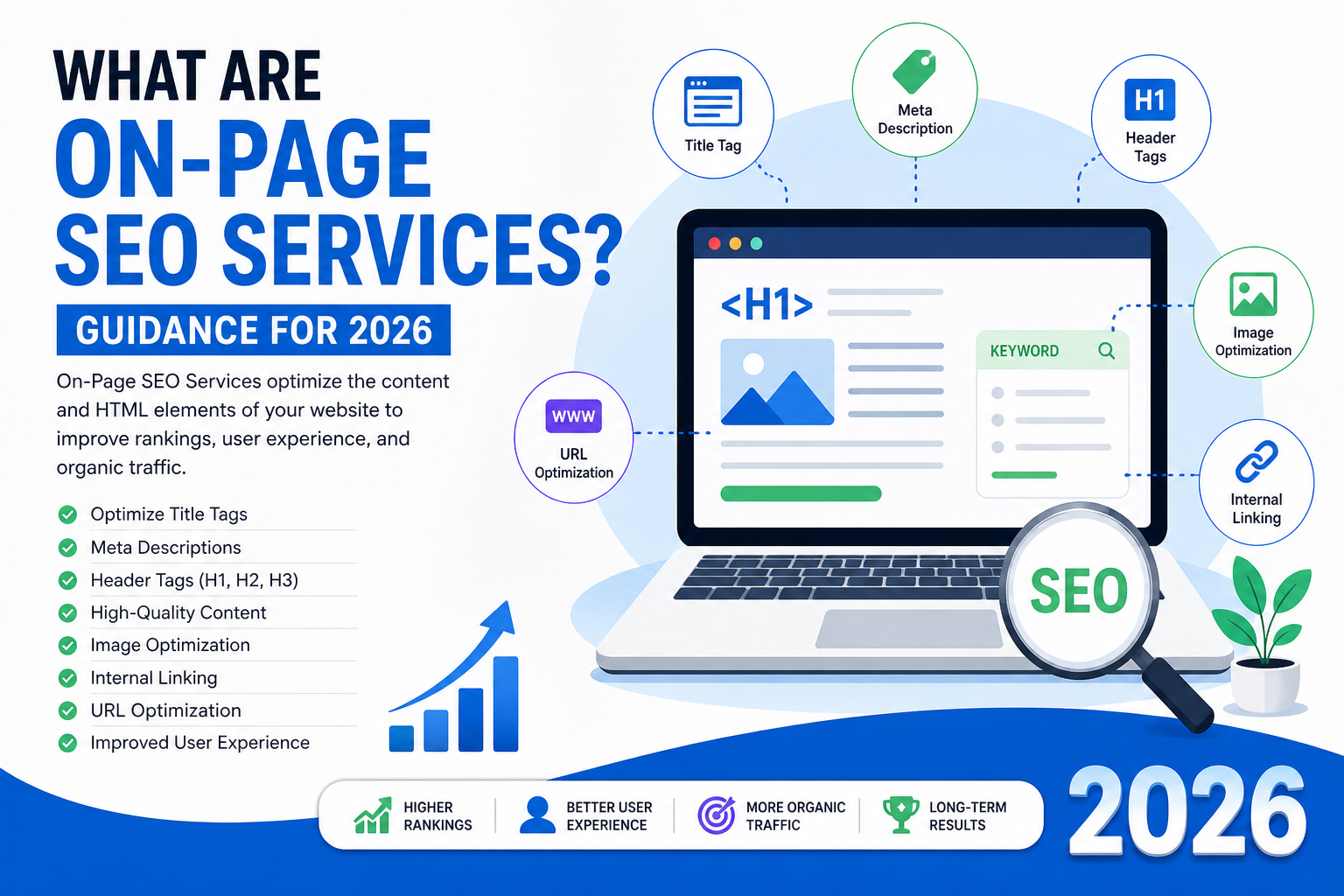
What Are On-Page SEO Services? Guidance for 2026
In 2026, SEO has become more competitive than ever. Every business wants to rank on Google’s first page because that is where the real traffic, leads, and sales come from. But ranking is not possible just by creating a website. You need proper SEO, and one of the most important parts of SEO is On-Page SEO.
On-Page SEO is the foundation of your website’s ranking. If your On-Page SEO is weak, your website may never reach top rankings, even if you have strong backlinks.
In this complete guide, you will learn what On-Page SEO services are, why they are important, and what activities are included in On-Page SEO in 2026.
What Is On-Page SEO?
On-Page SEO refers to all the optimization techniques that are performed inside a website to improve its ranking in search engines like Google, Bing, and Yahoo.
It includes optimizing your content, headings, keywords, internal linking, images, meta tags, URL structure, and user experience.
-On-Page SEO = Everything you do on your website to rank higher.
What Are On-Page SEO Services?
On-Page SEO services are professional SEO activities provided by SEO agencies or experts to optimize a website’s pages so that they rank higher in search results and attract more organic traffic.
These services ensure that your website is:
Properly structured for Google crawling and indexing
Optimized with relevant keywords and high-quality content
On-Page SEO services are usually done page-by-page, especially for service pages, blogs, category pages, landing pages, and homepages.
Why Are On-Page SEO Services Important in 2026?
In 2026, Google’s algorithm is smarter than ever. Google now focuses more on:
If your website doesn’t meet these requirements, ranking becomes difficult.
Top reasons why On-Page SEO matters in 2026
1. Google Needs Clear Signals
Google ranks pages that are easy to understand. On-page SEO helps search engines understand:
2. On-Page SEO Improves User Experience
A well-optimized page loads faster, looks better, and is easier to read. This reduces bounce rate and improves engagement.
3. Better Rankings Without Backlinks
If your content and on-page SEO are strong, you can rank even with fewer backlinks.
4. Higher Conversion Rate
On-page SEO is not just for ranking; it helps in increasing:
5. Helps You Beat Competitors
Most websites ignore proper on-page optimization. If you do it correctly, you can outrank bigger brands.
Key Elements of On-Page SEO Services
Now let’s understand what tasks are included in On-Page SEO services in detail.
1. Keyword Research & Keyword Mapping
Keyword research is the first step of On-Page SEO.
SEO experts identify the best keywords based on:
Commercial intent keywords
Keyword mapping
Keyword mapping means assigning the right keyword to the right page, so pages do not compete with each other.
Example:
This avoids keyword cannibalization and improves rankings.
2. Content Optimization
In 2026, content is still king, but only helpful and valuable content ranks.
Google’s algorithm can detect low-quality content, keyword stuffing, and AI-generated useless content.
Google ranks content that matches user intent:
If your content matches intent, ranking becomes easier.
3. Title Tag Optimization
The title tag is one of the strongest ranking factors.
It appears as the blue clickable headline in Google search results.
Best practices for title tags 2026:
keep it within 55–60 characters
include main keyword at the start
make it attractive and clickable
use power words like Best, Guide, Updated, Proven
add year if relevant 2026
Example:
On-Page SEO Services – Complete Guide for 2026
4. Meta Description Optimization
Meta description does not directly affect rankings, but it improves CTR.
Meta description best practices
Example:
Learn what On-Page SEO services include in 2026. Improve rankings, traffic, and conversions with the best on-page optimization strategies.
5. URL Optimization
SEO-friendly URLs help Google and users understand the page topic.
Good URL example
- yoursite.com/on-page-seo-services
Bad URL example
- yoursite.com/page?id=234&ref=seo
URL best practices
keep it short
include keyword
avoid special characters
use hyphens instead of underscores
avoid stop words like and, or, the
6. Heading Tags Optimization H1, H2, H3
Heading tags help structure your content.
Heading structure
H1 → Main title
H2 → Major headings
H3 → Sub-headings
H4 → Minor points
Best practices
include main keyword in H1
include related keywords in H2/H3
keep headings meaningful
avoid keyword stuffing
Example:
H1: What Are On-Page SEO Services?
H2: Why On-Page SEO is Important in 2026
H2: On-Page SEO Checklist
7. Image Optimization
Images improve user engagement, but unoptimized images slow down the website.
On-page SEO services include image optimization such as:
compressing image size
converting to WebP format
adding proper file names
adding ALT text
adding captions
ALT text example
Image file: on-page-seo-checklist.webp
ALT text: On-Page SEO checklist for 2026
ALT tags help in Google image ranking and improve accessibility.
8. Internal Linking Optimization
Internal linking means linking one page to another page within the same website.
Example:
A blog on SEO should link to:
SEO services page
technical SEO blog
keyword research guide
Internal linking is one of the most powerful SEO techniques in 2026.
9. External Linking
Outbound links are links to other trusted websites.
Google likes content that references trustworthy sources.
Outbound link best practices
link to high-authority sites
avoid spam websites
open external links in new tab
use relevant anchor text
Example:
Linking to Google Search Central, Wikipedia, or industry reports.
10. Keyword Placement & Optimization
Keyword placement matters more than keyword density in 2026.
Where keywords should be included
title tag
Avoid keyword stuffing. Google penalizes unnatural keyword usage.
Conclusion
On-page SEO services are one of the most important parts of SEO in 2026. They focus on optimizing your website internally so that search engines can understand it better and users can enjoy a smooth experience.
From keyword research and content optimization to page speed, mobile responsiveness, internal linking, schema markup, and Core Web Vitals, on-page SEO covers everything that improves your ranking potential.

08 October 2021

08 October 2021
08 October 2021